
Environmental Health Promotion and Policy
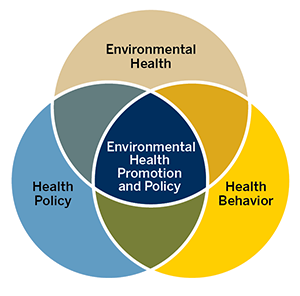 The Environmental Health Promotion and Policy (EHPP) MPH program will provide students with the public health background and skills to evaluate
environmental and occupational health risks and develop solutions based on health
promotion and policy tools to reduce such risks.
The Environmental Health Promotion and Policy (EHPP) MPH program will provide students with the public health background and skills to evaluate
environmental and occupational health risks and develop solutions based on health
promotion and policy tools to reduce such risks.
Exposures to environmental and occupational stressors, as well as potential mitigation strategies, are studied through a combination of courses in environmental health sciences, health behavior and health education, natural resources and the environment, health management and policy, and public policy. The environmental and public health knowledge gained through the program will provide the basis for designing and promoting innovative solutions that manage adverse occupational and environmental exposures and promote human health.
Graduates of the EHPP program will work in government agencies, non-governmental organizations, consulting firms, and industry to meet present and future needs for environmental health policy and promotion efforts necessary to improve public health by mitigating hazard exposure in communities and workplaces. There is a growing need for individuals with the skill set provided by this degree given the increasing number and complexity of environmental health hazards facing people in the US and across the globe.
Applicants to this program have a variety backgrounds and interests and the department welcomes applicants from all undergraduate majors. It is expected that the successful applicant will have at last one course in biology but no other specific undergraduate courses are required. The department places greater emphasis on overall sound scholarship and promise of development than on the precise focus of the baccalaureate degree. Specfiic admission requirements for the EHS MPH degree are found here.
Visit the EHS MPH degree site and the Admissions & Aid section of the U-M SPH site for details on the application process and financial aid options. Additional information for international applicants can be found here.
Curriculum
The EHPP program provides the foundation for understanding and anticipating environmentally- and occupationally-related health impacts, the skills for using this knowledge and available policy and health promotion tools to improve human health, and an understanding of approaches to evaluating the success or failure of environmental health interventions.
Sample Schedule
| Year 1: Fall | |
| EHS 510: Responsible Conduct in Research and Scholarship (RCRS) | 1 cr |
| EHS 601: Exposure Science and Health | 3 cr |
| 3 cr | |
| EHS 687: Professional Development in EHS I | 0.5 cr |
| PUBHLTH 500: Investigating Public Health Issues | 6 cr |
| Year 1: Winter | |
| EHS 597: Environmental Health Policy | 2 cr |
| EHS 603: Occupational and Environmental Disease | 3 cr |
| EHS 688: Professional Development in EHS II | 0.5 cr |
| PUBHLTH 501: Investigating Public Health Issues | 6 cr |
| Year 1: Summer 2026 | Internship/APEx Experience | |
| Year 2: Fall | |
| EHS 604: Professional Perspectives in EHS/EHS Capstone | 2 cr |
| EHS 689: Professional Development in EHS III | 1 cr |
| HBHEQ 690: Environmental Health Promotion | 3 cr |
| Year 2: Winter 2027 | |
| EHS 588: Environmental Law | 3 cr |
| HMP 653: Law and Public Health | 3 cr |
| Required: Quantitative Course (select one) | |
| EAS 635: Multivariate Statistics for Environmental Science | 3 cr |
| EAS 538: Natural Resource Statistics | 4 cr |
| BIOSTAT 522: Biostatistical Analysis for Health-Related Studies | 3 cr |
| EHS 655: Human Exposure Analysis | 3 cr |
| EHS/EPID 675: Data Analysis for Environmental Epidemiology | 3 cr |
| NUTR 620: Multivariate Analysis of Nutrition Related Studies | 3 cr |
| Select a minimum of one (1) of the following general policy courses (3 cr): |
| PUBPOL 650: Introduction to Science and Technology Policy Analysis |
| PUBPOL 563: Politics of Environmental Protection |
| PUBPOL 564: Government Regulation of Industrial and Environment |
| Select a minimum of one (1) of the following communication courses (3 cr): |
| EAS 566: Public Opinion and the Environment |
| HBHEQ 661: Designing Sticky Communications for Health Advocacy, Education, & Mass Media |
| HBHEQ 662: Risk Communication: Theory, Techniques, and Applications in Health |
| HBHEQ 668: Health Communication for Public Health |
| Select a minimum of one (1) for the following policy and regulation courses (3 cr): |
| EAS 558: Water Resource Policy |
| EAS 562: Environmental Policy, Politics, and Organizations |
| HMP 624: Health Policy Challenges in Developing Countries |
| LAW 679** Enviormental Law and Policy |
| NUTR 644: Global Food Systems Policy |
| PUBPOL 564: Government Regulation of Industry and the Environment |
| Select a minimum of 1 for the following program evaluation courses (3 cr): |
| HBHEQ 622: Program Evaluation in Health Education |
| PUBPOL 639: Quantitative Methods of Program Evaluation |
More Information
For answers to questions about the EHPP program, please contact:
Professor Tim Dvonch
Environmental Health Promotion and Policy Director
dvonch@umich.edu