

Conducting policy relevant research to mitigate and prevent environmental health inequities
Mission:
The Payne-Sturges Environmental Health Systems and Policy Lab aims to address long standing environmental and occupational health inequities using traditional epidemiological, human health risk assessment and innovative systems science methods to improve policies that impact the health of communities and populations, especially vulnerable, low income and minority populations in urban and rural settings. Our work is guided by community-based participatory research principles and draws upon theories from social sciences. Through interdisciplinary research, integrated systems modeling, community engagement and student training in system dynamics, EHSP Lab informs actionable solutions for just and sustainable environmental health systems.
The work:
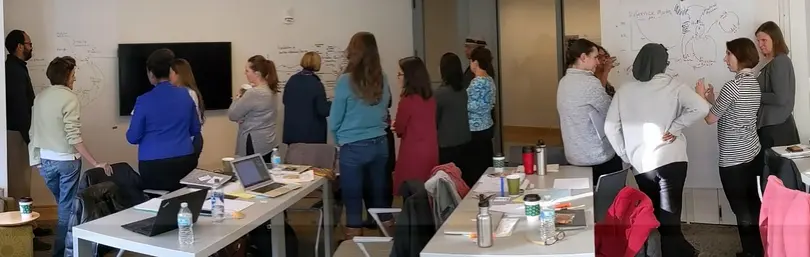
We are extending our work using system dynamics to examine structural racism and its relationship to environmental inequities. Structural racism (SR) has been defined as “the macro level systems, social forces, institutions, ideologies, and processes that interact with one another to generate and reinforce inequities among racial/ethnic groups” (Gee and Ford 2011; Powell 2008). A hallmark of the system dynamics (SD) approach is the integration of multiple sources of structural data to represent complex systems through the use of causal loop diagrams (CLDs) and other qualitative mapping approaches. Since summer 2021, we have facilitated seminars and workshops among researchers and experts in environmental exposures, child neurodevelopment, education, occupational health, labor law, environmental health policy, system dynamics modeling, and the study of structural racism to explore the contribution and potential application of system dynamics diagramming conventions to illuminate mechanisms and pathways of structural racism related to environmental and occupational health inequities.
The EHSP Lab is invested in building capacity in system dynamics among the next generation
of environmental health practitioners and researchers. We offer a graduate level course
that advances public health students’ systems thinking abilities, with a focus on
system dynamics (EHS 796). Students will develop their proficiency in identifying
and describing system dynamics concepts and apply these concepts to tackle dynamic
social problems with innovative and design driven transdisciplinary solutions.
Contact
Department: Environmental Health Sciences
Director: Devon Payne-Sturges, DrPH
Room Number: #6108 SPH II
Office Phone Number: (734) 764-3248
Email: devonps@umich.edu
I welcome intellectually curious and motivated undergraduates, graduate students and post-docs to join the Environmental Health Systems and Policy Lab. Students interested in a mentored independent research experience in environmental health and policy, please contact me directly. I also mentor students in the MPH and PhD in Environmental Health Sciences programs. For more information, please contact me directly.